Introduction
When you hear the phrase "legacy software," what comes to mind?
For most people, it conjures images of dusty mainframes running COBOL, or a forgotten office PC still running Windows 7. The accepted, traditional definition of "legacy" implies obsolescence—software that is old, outdated, and no longer supported by its vendor.
If we are talking about off-the-shelf commercial software, that definition is 100% accurate.

But when it comes to the custom software you built to run your business, the rules change entirely.
If you own a custom .NET application, it doesn't lose vendor support, because you are the vendor. To reframe the conversation and make smart decisions about your IT investments, we need to understand that in the world of custom software, "legacy" has a completely different definition.
Why “Legacy” ≠ Old for Custom software
In the software engineering world, we don't judge code by its birthday. We judge it by its maintainability.
A system becomes legacy not when the year changes, but when the understanding of the system degrades. At Innovensa, we have seen ten-year-old C# applications that are beautifully architected and a joy to maintain. Conversely, we have seen six-month-old applications that are an absolute nightmare because the sole developer rushed the build, wrote zero automated tests, and left the company.
Age is just a timestamp. Legacy is an operational state.
Defining Legacy: A Risk Profile, Not a Timestamp
If we discard age, how do we define legacy custom software?
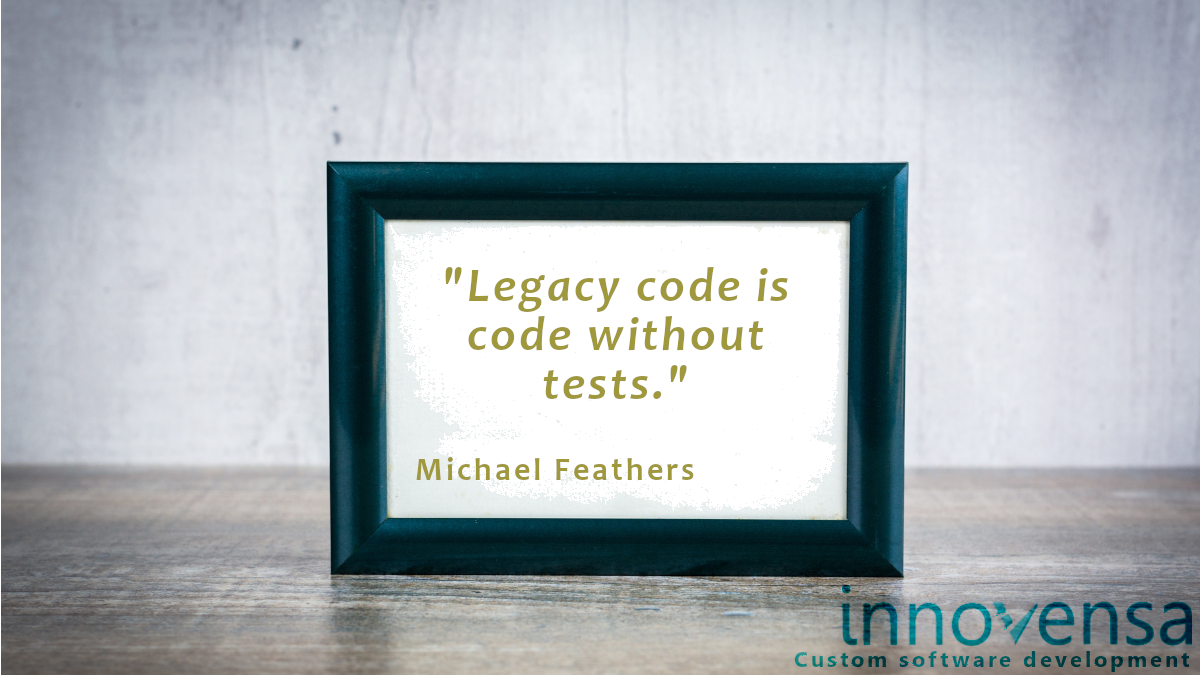
Legacy is a risk profile. It is a measure of the friction, cost, and fear required to change the system. One of the most famous definitions in software engineering states simply: "Legacy code is code without tests." Why? Because changing it is a gamble.
You know you are dealing with a high-risk legacy system when you recognise these symptoms:
- Fear of Deployment: Your team holds their breath every time an update goes live because they aren't sure what unintended side effects will occur.
- The "Hero" Developer: Only one specific person in the company knows how the core logic works, and they are becoming a bottleneck.
- Sluggish Velocity: A feature that used to take a week to build now takes a month because the codebase is too tangled.
When you view your software through this lens, you stop thinking emotionally about how "old and ugly" the code is, and start thinking structurally about business exposure.
The Paradox of Success: Why Good Systems Go Bad
It is easy to blame bad developers for legacy code, but the irony is that systems usually become legacy because they were successful.
Think about your core business application. Over the years, your business has evolved. You’ve added new service lines, integrated with third-party APIs, and adapted to new compliance laws. Your software survived all of that. It was bent, twisted, and patched to accommodate every pivot your business made.
Over time, those layers of urgent, successful adaptations obscure the original architecture. The system didn't rot; it was crushed under the weight of its own success.
The Siren Song of the "Big Rewrite"
Once a system’s risk profile becomes too high, the natural instinct is to throw it away and start over.
The myth that a "rewrite fixes everything" is one of the most pervasive—and financially destructive—ideas in software development. Here is why big-bang rewrites almost always fail:
- Hidden Business Logic: That messy code you want to delete contains years of hard-won edge cases and bug fixes. When you rewrite from scratch, you delete institutional knowledge.
- The Moving Target: While your team spends two years rewriting the old system to get back to square one, your competitors are building new features.
- The Same Mistakes: If you don't change the team structure and testing habits that created the messy code in the first place, your shiny new system will become a legacy system within a year.
Stop Guessing. Get a Diagnosis.
You don't have to live with the fear of deployment, but you also shouldn't write a blank cheque for a total system rewrite.
Before you make a high-stakes decision about the future of your .NET application, you need to measure its exact risk profile.
Are you ready to lift the lid on your legacy system?
We offer a specialised, fixed-price .NET Legacy Stability Audit. In just 3 to 5 days, our directors will perform a forensic "White Box" review of your code, database, and infrastructure to give you a clear Red-Amber-Green scorecard and a practical roadmap to stability.
👉 Explore our .NET Legacy Stability Audit and contact us today..
In this series...
In the next post of our .NET Legacy Software Series, we will explore exactly how this happens to good companies in "How Custom Software Becomes Legacy" —unpacking the accidental architecture, developer churn, and business pressures that create technical debt.
➡️ Next: How Custom Software Becomes Legacy: The Four Silent Traps